
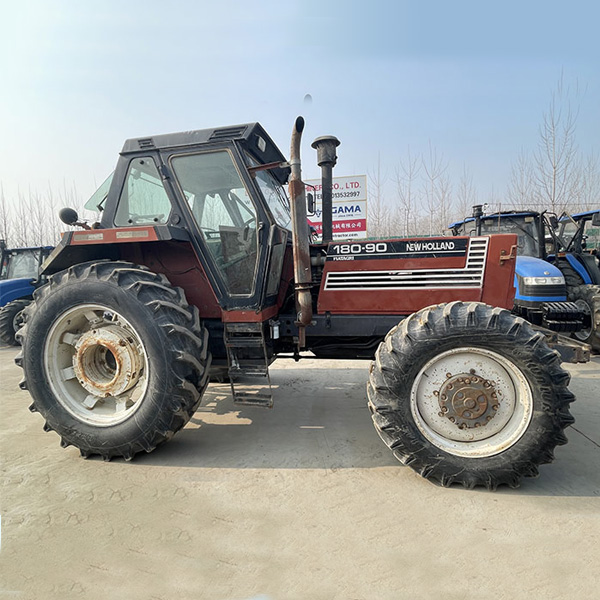
A tractor Fiat 180-90 earns its keep above roughly 200 hectares, or wherever one operator runs 4-5 m implements. It shares an 8.1 litre turbocharged six, a 24-speed partial powershift and a 6,730 kg working mass with the 160-90. One big machine means one fuel bill, one operator and one service interval. The trade-off is freight: at 2,890 mm tall it will not clear a 40HQ door. Choose the tractor Fiat 180-90 for heavy draught on dry ground; keep two 80 hp units if you work two blocks at once or farm wet soil.
Tractor Fiat 160-90 and 180-90: one block, two ratings
Both machines are 4x4 MFWD units built around the same Fiat turbocharged diesel six-cylinder: 115 x 130 mm bore and stroke, 8.1 litres displacement, rated at 2,200 rpm. Same block, same injection pump, same 280.1 litre tank. The only difference is the rating.
| Specification | FIAT 160-90 | FIAT 180-90 |
|---|---|---|
| Rated power | 160 hp / 119.3 kW | 180 hp / 134.2 kW |
| Power per litre | 19.8 hp/L | 22.2 hp/L |
| Transmission | 24-speed partial powershift | 24-speed partial powershift |
| Fuel tank | 280.1 L | 280.1 L |
| Weight | 6,730 kg | 6,730 kg |
Twenty-two horsepower per litre is a conservative tune. That is the point: the engine is not stressed. A used tractor Fiat that still reaches rated speed under load has a healthy turbo and a clean air path; one that falls 200 rpm short in a yard test has a fuel or intake restriction, which is a negotiating item rather than a rebuild.
What the partial powershift does under load
A partial powershift splits ranges without touching the clutch. On headlands and rolling ground that matters more than the speed count: you hold the engine near its rated speed, where specific fuel consumption is lowest, instead of lugging or screaming. Operators coming from a synchromesh box notice the difference in clutch life inside a season.
Fuel is the other half. At a typical 240 g/kWh, 134.2 kW at full drawbar load burns about 32 kg of diesel an hour, roughly 38 litres. The 280.1 L tank on a tractor Fiat of this size covers close to seven hours of ploughing, or a full day of seeding and hauling. Two 80 hp machines with 90-120 L tanks need two stops to cover the same window.
Tractor Fiat ballast: 6,730 kg split two ways
Divide the mass by the rating and the two are not the same tractor. The 160-90 carries 42.1 kg per horsepower, the 180-90 only 37.4. Above roughly 32 kg/hp a machine pulls a heavy implement at 10-15% slip on dry ground, so both arrive well ballasted. The 180-90 is the one that needs front weights first: the same chassis and the same 6,730 kg now carry twenty more horsepower.
GAMA gmtractor.com
The other side of that mass is compaction. Six point seven tonnes on soil near field capacity does more damage than an 80 hp machine at about 3,000 kg. That is the honest limit of a big tractor Fiat: outstanding on dryland tillage, the wrong tool in a wet paddock.
One 180-90 or two 80 hp units
The decision is not about horsepower. It is about your calendar and your soil.
| Factor | One 180-90 | Two 80 hp units |
|---|---|---|
| Operators per day | 1 | 2 |
| Engines to service | 1 | 2 |
| Fuel per shift | 280 L, one tank | 200 L, two tanks |
| Fields at once | 1 | 2 |
| After a breakdown | all work stops | half fleet runs |
| Mass per pass | 6,730 kg | 3,000 kg each |
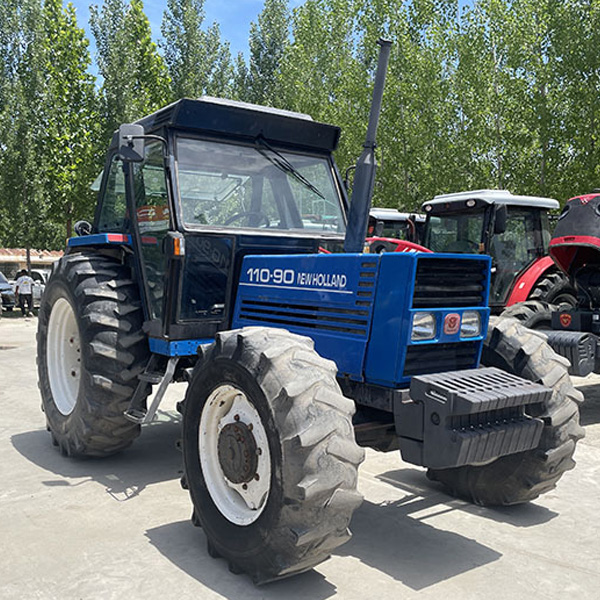
A useful rule of thumb: total your annual engine hours on primary tillage. Above roughly 800-1,000 hours a year, one 180 hp machine costs less per hour than two smaller ones. Below that, or where blocks are small and scattered, two mid-size units win. In the middle, a used tractor Fiat 110-90 at 110 hp and 4,670 kg is the step-down worth pricing.
Tractor Fiat freight: 2,890 mm and the flat-rack call
A standard 40HQ gives about 12,032 mm of internal length and a door opening near 2,580 mm. These machines stand 2,890 mm to the top of the cab, roughly 300 mm too tall, and pulling the exhaust and mirrors recovers only 150-200 mm. Book a 40 ft flat rack instead of cutting the cab off a machine you plan to resell. Every tractor Fiat of this series is 442 cm long, so two nose to tail take 8,840 mm of floor. At 6,730 kg each, two come to 13,460 kg, well inside a rack payload, and the rest of the floor carries implements and a pallet of filters.
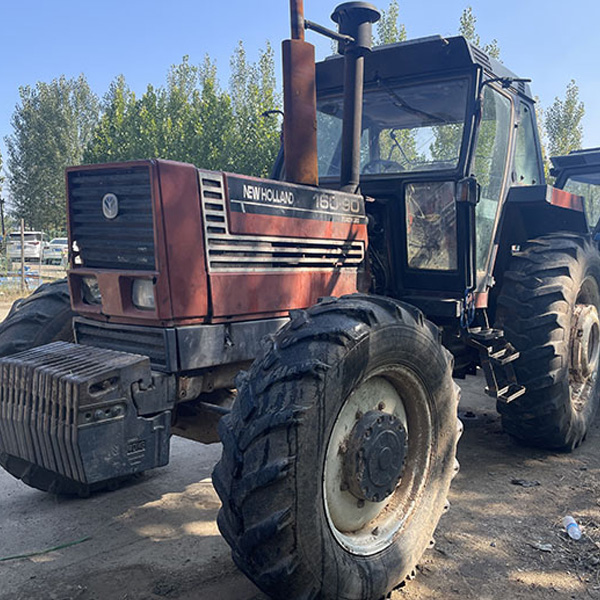
Before you book, send four things: engine hours, tyre sizes, whether the cab is a low-roof version, and the age rule at your port. Many markets cap used machinery at 10 or 15 years, and that number decides whether a unit is worth quoting.
gmtractor.com +86 13013532997
FAQ
Can one tractor Fiat 180-90 really replace two 80 hp tractors?
On draught work, yes. At 180 hp and 6,730 kg it pulls in one pass what two 80 hp machines cover in two, with one operator and one fuel account. It cannot be in two fields at once, and it puts more weight on the soil. If a breakdown would stop your season, keep a second machine whatever the maths says.
GAMA gmtractor.com
Does a Fiat 180-90 fit in a 40HQ container?
No. At 2,890 mm it clears neither the 2,580 mm door nor the high-cube roof line. Ship it on a 40 ft flat rack, two units per rack at 13,460 kg combined. Removing the cab would make it fit, but it costs resale value and workshop time at both ends.
Where to inspect one
Linyi Gama Machinery Co., Ltd keeps used FIAT NEW HOLLAND 180-90 and FIAT NEW HOLLAND 160-90 units in stock in Linyi City, Shandong Province, China. Each machine is run, loaded and checked before listing, and we send the hour reading, tyre sizes and photographs before you travel. Send your implement widths and annual hours to Gavin@gamagr.com or call and message +86 13013532997, and we will say plainly whether a tractor Fiat 160-90 or 180-90 suits your ground.